Projects · 01
Sightline
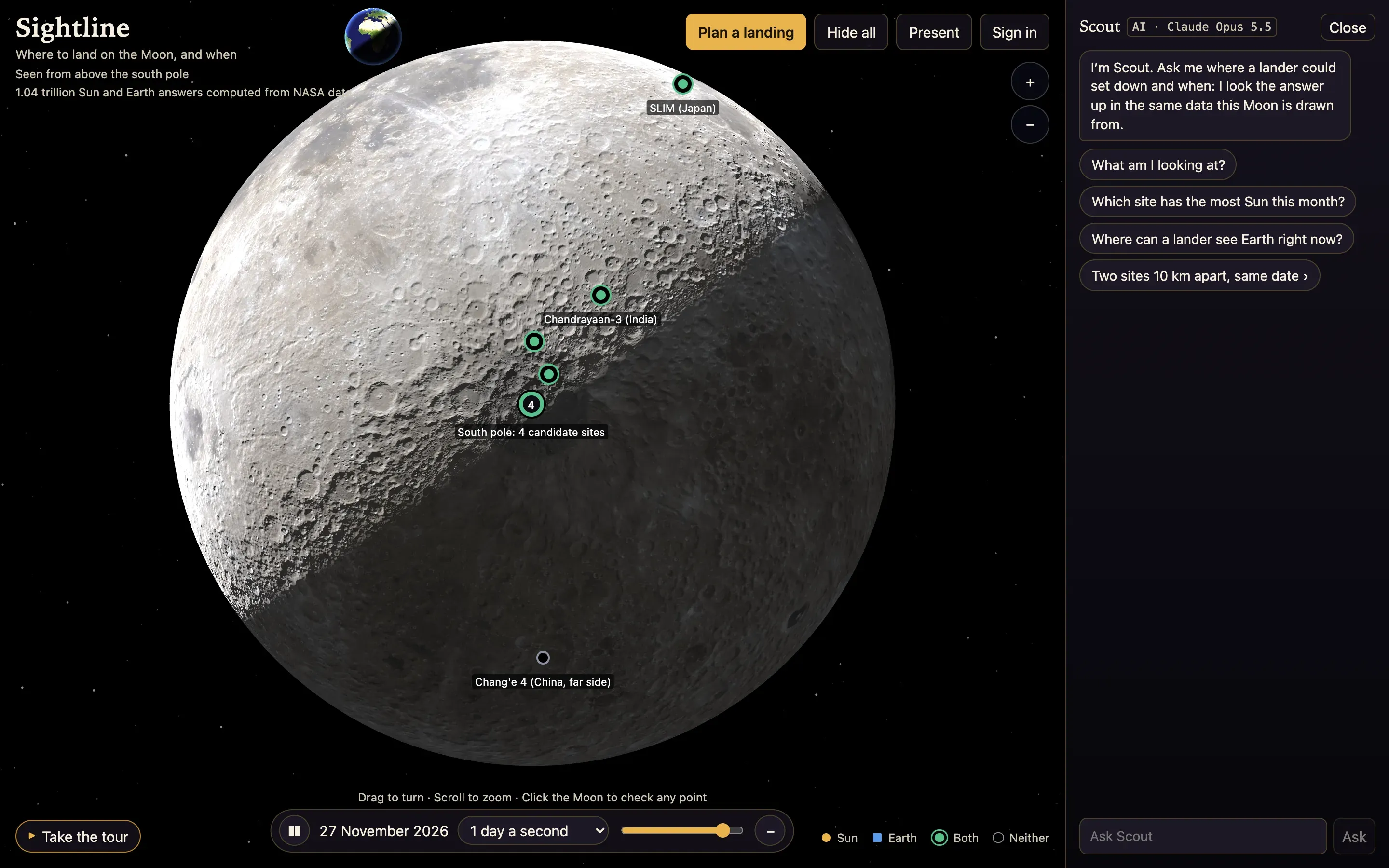
A lunar landing-site planner. It shows when the Sun and Earth are in view from a landing site at the Moon's south pole, every hour from 2026 to 2049, and whether a landing date fits a mission's limits.
- My part
- I led the six-person team behind it (NASA Space Apps 2026) and owned the architecture decisions. AI coding agents wrote most of the code, under my direction and review.
- Result
- Sun and Earth positions match JPL Horizons within 0.0071° over 5,469,984 hourly checks. Deploys go out as a canary and roll back automatically. 2,020 tests run in CI.
- Stack
-
- Python
- TypeScript and React
- Google Cloud Run
- Terraform
- Firestore
- Redis
- Pub/Sub and BigQuery
- GitHub Actions
What it does
A lander at the Moon’s south pole needs the Sun for power and Earth for a direct radio link, and there both only skim the horizon, so the hills decide when each is in view. Sightline computes that from NASA’s terrain and ephemeris data for 13 sites, every hour from 2026 to 2049.
You pick a site, a landing date and a mission: how long it lasts, how much darkness and radio silence it can take. Sightline answers in words. It fits, it fits with little margin, or it does not and why, with the next landing that does.
How it is built
A Python pipeline reads NASA’s LOLA terrain models and SPICE kernels and computes the horizon and the Sun’s and Earth’s positions for each site. The front end is React and TypeScript.
It runs on Google Cloud as four Cloud Run services, each with its own image, identity and deploy: the web server, saved plans, the co-pilot, and a private worker that counts questions. A global load balancer with a CDN and an edge firewall sends each path to its service. Every piece of it is declared in Terraform and applied from GitHub Actions, which signs in to Google Cloud with no stored keys.
Merging to main deploys one service at a time. Each new version starts with no visitors, is
tested, then takes a share of traffic, and rolls back by itself if its checks fail.
Who wrote the code
AI coding agents wrote most of it: nearly all the code, tests, Terraform and docs. I set the
direction, reviewed the work and made the calls, and I led the six people on the team. The
repository says the same in its AI_USAGE.md.
The architecture decisions were mine to make. Three of them: one server split into four services with separate identities, the rule that the co-pilot never types a number (the server fills in every figure from computed data), and deploys that prove themselves before visitors reach them.
Architecture · scroll sideways for all of it →
Where these claims come from
-
Led the six-person team, owned the architecture decisions, directed AI coding agents that wrote most of the code.
Resume, Systems Built; the repository README names the team of six and its captain.
-
Matches JPL Horizons within 0.0071° over 5,469,984 hourly checks; 2,020 tests in CI; canary deploys with automatic rollback.
Resume, Systems Built. The repository README carries the 5,469,984 figure.
-
Four Cloud Run services behind a load balancer, CDN and Cloud Armor; Firestore, Redis, Pub/Sub into BigQuery; Terraform applied from GitHub Actions with no stored keys.
-
13 sites, every hour from 2026 to 2049; 1.04 trillion Sun and Earth answers computed.